
Chronological Age vs Mental Age: Key Differences Explained
Have you ever felt like your age doesn’t really match how you think or behave? Or you ever met a 10-year-old who speaks with the wisdom of an adult? Or maybe a 40-year-old who still gets excited like a kid on a playground? This is not just a personality trait, it is actually related to your mental age. In this guide, we are going to go deeper as why this happens and the differences between chronological age vs mental age. We will look into the factors which impact your mental age and the ways to improve so your mind always feels young.
Understanding Chronological Age vs Mental Age
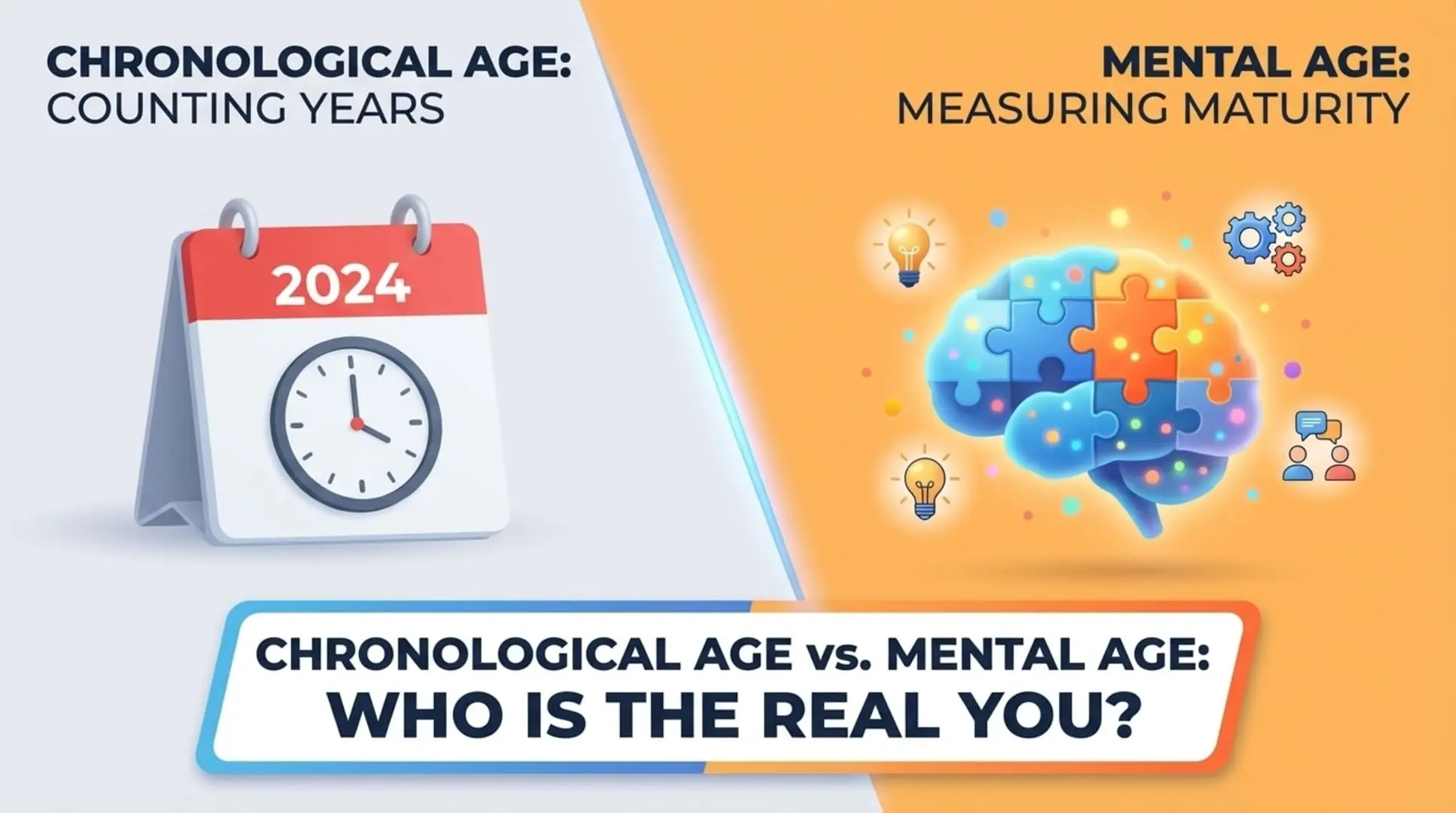
In simple terms, the main difference between chronological age vs mental age is that chronological age measures the time since birth, while mental age shows a person’s thinking ability and cognitive development.
Understanding Chronological Age
Your chronological age is simply the number of years that have passed since your date of birth. It is your actual age according to the calendar. If you’re still confused about chronological age, we have already explained it in detail in our blog Chronological Age. You can also use our Chronological Age Calculator to quickly calculate your exact age in years, months, and days.
What Is Mental Age
Mental Age is defined as the person’s level of mental development and maturity relative to the average person of the same chronological age. The term was first introduced by psychologist Alfred Binet, who created the first intelligence test.
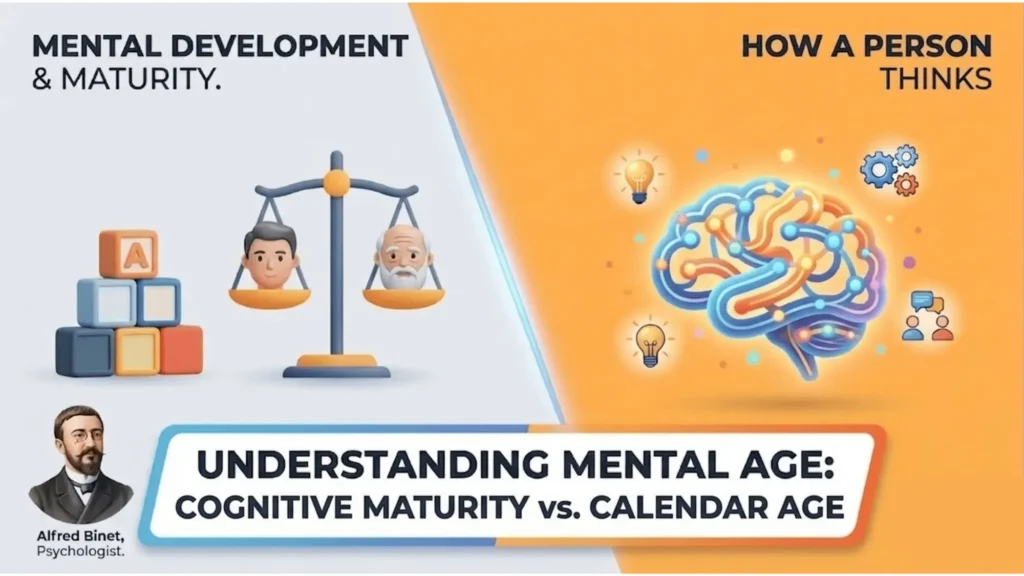
Mental age, unlike Chronological age, shows how a person thinks, such as how they solve problems, reason, and handle situations.
Note:
Mental age is sometimes used informally to describe emotional maturity, such as how someone handles stress or responsibilities. However, it is not a strict medical diagnosis.
Is Mental Age same as IQ?
The simple answer is NO. Although they are directly related to each other. Mental age is the person’s level of thinking ability. On the other hand, IQ ( Intelligence Quotient) is a score that represents how that performance compares to other people of the same chronological age.
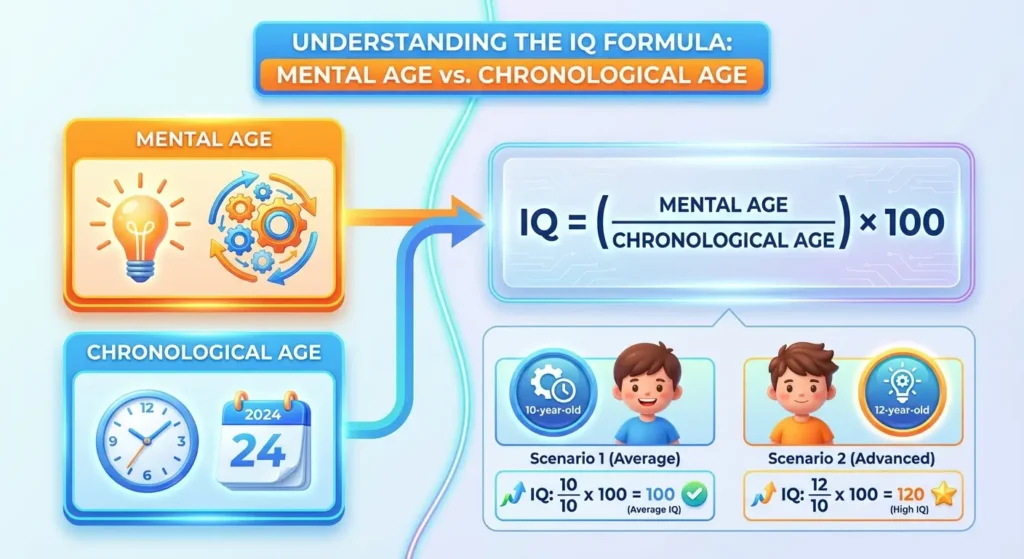
In the early days of psychology, IQ was calculated using a specific formula where mental age was divided by the chronological age and then multiplied by 100.
Mental Age IQ Formula
Note: Try our chronological age calculator for quick and accurate results.
For example, if a 10-year-old (chronological age) has the reasoning skills of a 10-year-old (mental age), their IQ would be 100, which is considered the average. If their skills match a 12-year-old, their IQ would be 120.
Note: Modern IQ tests no longer rely on the above mentioned formula and use standard scoring methods instead.
Chronological Age vs Mental age: The Difference Explained
The main difference between chronological age vs mental age is that chronological age measures the time since birth, while mental age is a person’s cognitive development and maturity. Here, we are giving you a quick comparison so you can fully understand the chronological age vs mental age differences.
| Features | Chronological Age | Mental Age |
|---|---|---|
| Definition | The time passed from the person’s birth | Person’s mental maturity and reasoning |
| Based On | Calendar date | Intellectual and emotional development |
| Measurement Method | Measured from the date of birth | Determined by observations or standard tests |
| Practical Use | Legal purposes, school placement | Understanding social behaviours and learning |
| Stability | Always increases | Can vary depending on development |
What Does It Mean If Mental Age Seems Lower Than Chronological Age?
If someone’s mental age is lower than their chronological age, it may mean their thinking skills or social maturity do not match what is usually expected for their age. Understanding this is one of the key points when comparing chronological age vs mental age. This does not always mean there is a problem. It simply shows how someone handled the situation at a certain time.
It may suggest that;
- Their reasoning or problem solving skills are developing differently.
- Their learning experiences have been different from others in the same age group.
- They perform differently on certain types of cognitive assessments.
- Their strengths may lie in areas that are not fully assessed by tests.
It is important to remember that mental age is a concept only, not a medical diagnosis. It does not define a person’s IQ, abilities to handle situations. A person’s performance can change over time with learning and new experiences.
What Influences Your Mental Age
As you know that the mental age of a person is variable and can be changed unlike your chronological age which only goes up. And there is not any single factor that influence your mental age rather a combination, such as

Your Childhood
Like how your childhood environment was, whether you were encouraged to learn or handle responsibilities as a child may helped who you are today.
Life Experiences
What you did in your life ,travelling, starting a job or how you handled any situation helps you grow and become more mature.
Your Daily Routine
Your daily routine is important, Whether you stay active or relax, your physical health can influence your thinking and focus.
Your Feelings
The way you feel in your past life and how had you handled your feelings or failures in life plays a role in your emotional maturity.
Note: All of these factors together shape the maturity of your inner self.
Does Mental Age Affect Daily Life?
Yes, mental age can affect daily life, the choices you make and the environment you grew up in can affect your decision making, handling responsibilities and managing emotions. This is why understanding chronological age vs mental age can give you a better perspective on personal growth. It can also impact how you experience everyday situations:
A slightly higher mental age may help you manage stress and solve problems more effectively in your practical life.
A lower mental age may make certain responsibilities feel more overwhelming at times, especially during adulthood.
Mental Age vs Biological Age and Which Matters More?
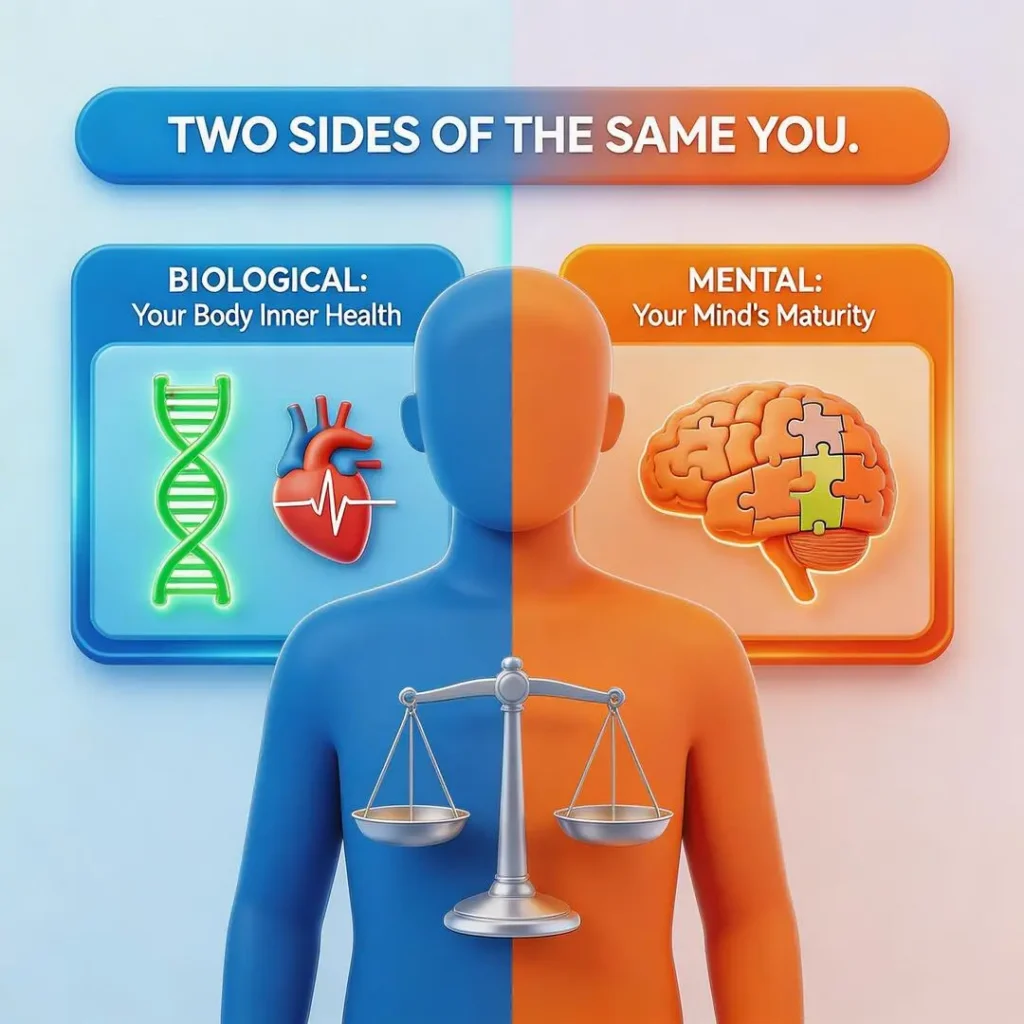
People often use the term Physical Age when talking about the Biological Age. While both ages are important, they look at different parts of your life:
Biological Age
This is about your body’s inner health. It shows how well your body internally is working. You can improve it through regular exercise and healthy eating habits.
Mental Age
This is about your inner maturity. It measures how you handle stress, solve problems, and get along with others.
Why is Mental Age Generally Different from Biological Age?
Many of us often wonder why there is a difference in our Mental and biological age. Why does our mind sometimes feel older (or younger) than our body? As we know, the mental age measures the thinking abilities and emotional maturity. On the other hand, Biological age is your inner age i.e how your body functions. They are different because they both covers different things;
- Mental age is your mind age, it is based on your life experiences, ability to handle responsibilities and the environment you grew up in.
- Your Biological or Body’s age is based on your habits, daily routine, and lifestyle choices.
Because your life journey is unique, it is very common for your mind to feel a different age than your body.
Which Matters More
It depends on your goal. Biological age helps you understand your physical health. Mental age helps you grow in your career and relationships. Both ages tell you who you are.
Frequently Asked Questions
Final Words
We hope that this look at chronological age vs mental age answer your questions as both are simply different ways to tell age, i.e. one for the body and one for the mind. Understanding mental age is a fun way to look at your personality. Keep in mind that the mental age number is not fixed. Whether it is higher or lower than your chronological age, you can always change it by learning new things, changing good daily habits and taking a new challenge.
Your chronological age tells the world your age based on your date of birth, but mental age shows your emotional growth and maturity. You can calculate it easily using our Chronological Age Calculator. Remember, the most important thing is your own comfort. Use your mental age to better understand yourself and keep growing at your own pace.
Disclaimer:
This content is for informational and educational purposes only and is not intended as medical or psychological advice. Mental age is a theoretical concept used in cognitive assessments and should not be used to diagnose any health condition or intellectual disability. Always consult with a qualified healthcare professional or a licensed psychologist if you have specific concerns about cognitive development or mental health.
References & Further Reading
- Binet’s Intelligence Test (Historical Origins): Learn about the first valid test of intellectual ability developed by Alfred Binet, which established the concepts of mental age and IQ, via Britannica – Alfred Binet: Biography & Contributions.
- The Concept of IQ: Understanding how Mental Age was traditionally used to calculate the Intelligence Quotient (IQ) via Verywell Mind: History of Intelligence Testing.
- Cognitive Development: Learn how mental abilities are assessed and compared across different age groups through research from the National Institutes of Health (NIH) – Cognitive Assessment.