
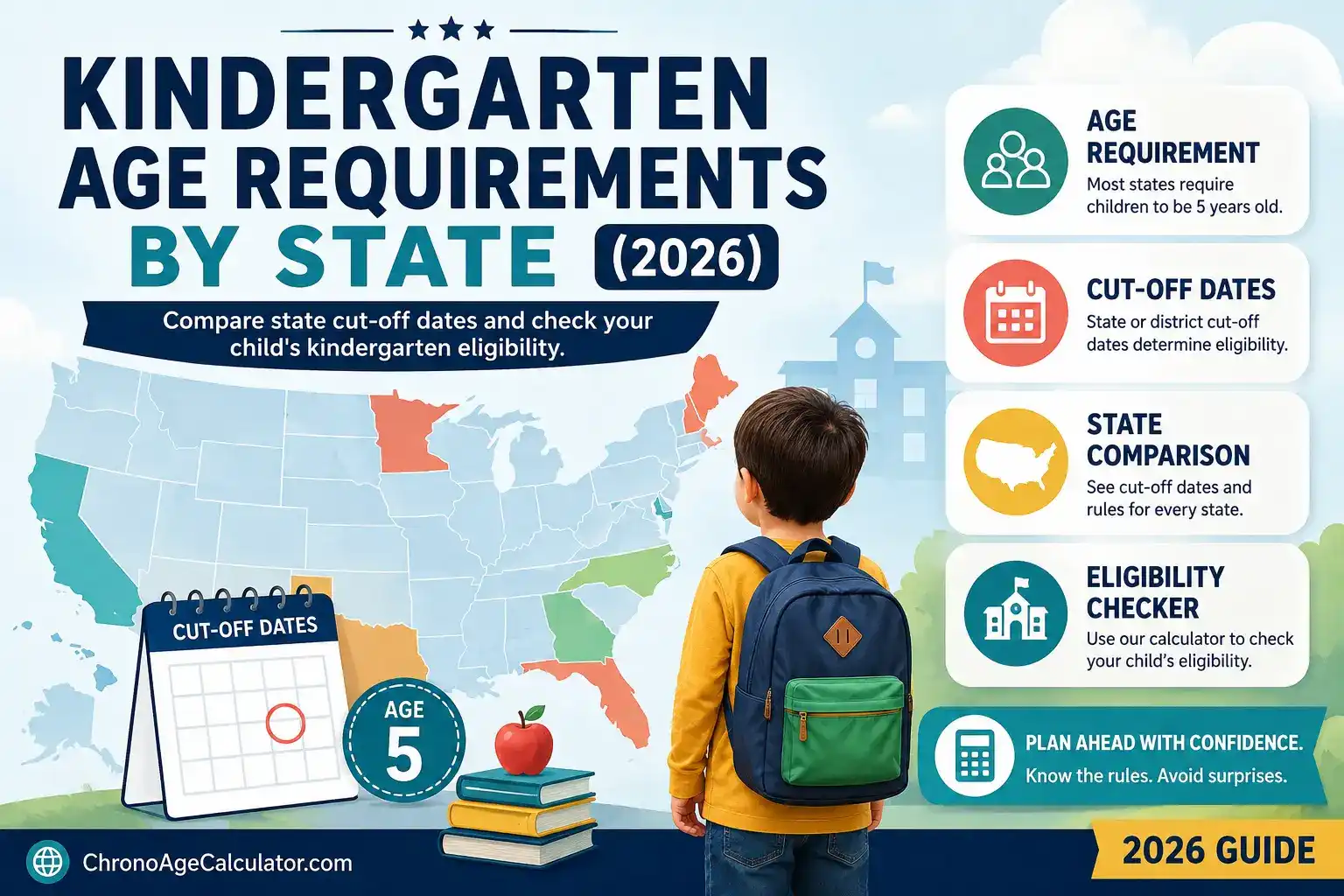
Kindergarten Age Requirements by State (2026 Guide)
Most children in the United States start kindergarten at 5 years old, but the exact age requirement depends on your state’s kindergarten cut-off date. A child who qualifies in one state may not be eligible in another because enrolment rules vary across the country.
In this guide, you’ll find the latest kindergarten age requirements by state, cut-off dates, early entry rules, and answers to the most common parent questions. You can also use our School Age Calculator to check your child’s estimated kindergarten eligibility in seconds.
Quick Answer
-Most children start kindergarten at 5 years old.
-Every U.S. state has its own kindergarten cut-off date.
-Some states allow local school districts to set additional enrolment rules.
-Use our Student Age Calculator to estimate kindergarten eligibility in seconds.
Last Updated: August 2026
What Are Kindergarten Age Requirements by State?
Kindergarten age requirements are the minimum age and enrolment rules a child must meet before starting kindergarten in a particular U.S. state. While kindergarten eligibility is based on a child’s chronological age, most states require children to be 5 years old. However, eligibility depends on more than just a child’s birthday. Each state sets its own kindergarten cut-off date, which determines whether a child can enrol for the upcoming school year or must wait until the following year.
Unlike many education policies that follow similar standards nationwide, kindergarten entry requirements are established at the state level. This means there is no single age rule that applies across the United States. For example, one state may require a child to turn 5 by September 1, while another uses an earlier or later cutoff date. Some states also allow school districts or local education authorities to apply additional enrollment policies or offer limited early-entry options.
Because of these differences, two children with the same birth date may not be eligible to start kindergarten in the same academic year if they live in different states. That’s why checking your state’s current age requirement is the first step before beginning the enrolment process.
Check Kindergarten Age Requirements by US State
US school enrollment rules are not the same across all states, especially when it comes to kindergarten entry age and cut-off dates. Most states follow a September 1 cut-off date, meaning a child must turn 5 before that date to be eligible for kindergarten. However, states like Hawaii, New York, and New Jersey use different cut-off dates or district-based policies.
This section helps parents quickly understand their state’s basic requirements so they can estimate when their child is likely to start kindergarten without spending hours researching different state rules. Select your state below to view the minimum kindergarten age, cut-off date, and basic eligibility requirements
State Kindergarten Eligibility Rules
Select your state to view the kindergarten age requirement, cut-off date, and basic eligibility information.
Pro Tip
Always verify with your local school district as some regions within a state may have slightly different enrollment rules.
State Cut-off Dates Comparison (US Kindergarten Entry Rules)
Schools in the United States use state-defined cut-off dates to determine kindergarten eligibility. These dates decide whether a child is eligible to start school in a particular academic year. Because cut-off rules vary by state, children with similar birthdates may start school in different years depending on their location. For example, a child born in August may start kindergarten in California in the same year (September 1 cut-off), while in New Jersey (October 1 cut off), the same child may become eligible in a different academic year. The table below compares key state cut-off dates and entry examples.
| State | Cut-off Date | Rule Type | Eligibility |
|---|---|---|---|
| Alabama | September 1 | Statewide | Eligible if child turns 5 by Sept. 1 |
| Alaska | September 1 | Statewide | Eligible if child turns 5 by Sept. 1 |
| Arizona | August 31 | Statewide | Eligible if child turns 5 by Aug. 31 |
| Arkansas | August 1 | Statewide | Eligible if child turns 5 by Aug. 1 |
| California | September 1 | Statewide | Eligible if child turns 5 by Sept. 1 |
| Colorado | District Option | Local District | Check your local school district |
| Connecticut | September 1 | Statewide | Eligible if child turns 5 by Sept. 1 |
| Delaware | August 31 | Statewide | Eligible if child turns 5 by Aug. 31 |
| District of Columbia | September 30 | Statewide | Eligible if child turns 5 by Sept. 30 |
| Florida | September 1 | Statewide | Eligible if child turns 5 by Sept. 1 |
| Georgia | September 1 | Statewide | Eligible if child turns 5 by Sept. 1 |
| Hawaii | July 31 | Statewide | Eligible if child turns 5 by July 31 |
| Idaho | September 1 | Statewide | Eligible if child turns 5 by Sept. 1 |
| Illinois | September 1 | Statewide | Eligible if child turns 5 by Sept. 1 |
| Indiana | August 1 | Statewide | Eligible if child turns 5 by Aug. 1 |
| Iowa | September 15 | Statewide | Eligible if child turns 5 by Sept. 15 |
| Kansas | August 31 | Statewide | Eligible if child turns 5 by Aug. 31 |
| Kentucky | August 1 | Statewide | Eligible if child turns 5 by Aug. 1 |
| Louisiana | September 30 | Statewide | Eligible if child turns 5 by Sept. 30 |
| Maine | October 15 | Statewide | Eligible if child turns 5 by Oct. 15 |
| Maryland | September 1 | Statewide | Eligible if child turns 5 by Sept. 1 |
| Massachusetts | District Option | Local District | Check your local school district |
| Michigan | September 1 | Statewide | Eligible if child turns 5 by Sept. 1 |
| Minnesota | September 1 | Statewide | Eligible if child turns 5 by Sept. 1 |
| Mississippi | September 1 | Statewide | Eligible if child turns 5 by Sept. 1 |
| Missouri | July 31 | Statewide | Eligible if child turns 5 by July 31 |
| Montana | September 10 | Statewide | Eligible if child turns 5 by Sept. 10 |
| Nebraska | July 31 | Statewide | Eligible if child turns 5 by July 31 |
| Nevada | September 30 | Statewide | Eligible if child turns 5 by Sept. 30 |
| New Hampshire | District Option | Local District | Check your local school district |
| New Jersey | District Option | Local District | Check your local school district |
| New Mexico | September 1 | Statewide | Eligible if child turns 5 by Sept. 1 |
| New York | District Option | Local District | Check your local school district |
| North Carolina | August 31 | Statewide | Eligible if child turns 5 by Aug. 31 |
| North Dakota | July 31 | Statewide | Eligible if child turns 5 by July 31 |
| Ohio | District Option | Local District | Check your local school district |
| Oklahoma | September 1 | Statewide | Eligible if child turns 5 by Sept. 1 |
| Oregon | September 1 | Statewide | Eligible if child turns 5 by Sept. 1 |
| Pennsylvania | District Option | Local District | Check your local school district |
| Rhode Island | September 1 | Statewide | Eligible if child turns 5 by Sept. 1 |
| South Carolina | September 1 | Statewide | Eligible if child turns 5 by Sept. 1 |
| South Dakota | September 1 | Statewide | Eligible if child turns 5 by Sept. 1 |
| Tennessee | August 15 | Statewide | Eligible if child turns 5 by Aug. 15 |
| Texas | September 1 | Statewide | Eligible if child turns 5 by Sept. 1 |
| Utah | September 1 | Statewide | Eligible if child turns 5 by Sept. 1 |
| Vermont | District Option | Local District | Check your local school district |
| Virginia | September 30 | Statewide | Eligible if child turns 5 by Sept. 30 |
| Washington | August 31 | Statewide | Eligible if child turns 5 by Aug. 31 |
| West Virginia | August 31 | Statewide | Eligible if child turns 5 by Aug. 31 |
| Wisconsin | September 1 | Statewide | Eligible if child turns 5 by Sept. 1 |
| Wyoming | September 15 | Statewide | Eligible if child turns 5 by Sept. 15 |
Note:
Kindergarten entry dates shown above are based on statewide policies or district-level rules available for the 2026 enrollment cycle. Local school districts may update enrollment policies, early entrance procedures, or exceptions. Always confirm eligibility with your local school district before registering your child.
Understanding Kindergarten Cutoff Dates
A kindergarten cut-off date is the deadline by which a child must turn 5 years old to start kindergarten for that school year. If your child’s birthday falls on or before the cut-off date, they’re usually eligible to enrol. If it’s after the cut-off, they’ll typically start the following school year. Since cut-off dates aren’t the same across the U.S., a child may qualify in one state but not in another. School admission is determined using chronological age, so understanding how age is calculated can help parents avoid enrolment mistakes.
For example:
That’s why checking your state’s cutoff date is only the first step. If you live in a district-option state, always confirm the enrollment requirements with your local school district before registering your child.
Common Parent Questions
Every family’s situation is different, and small differences in a child’s birthday, state, or school district can affect kindergarten eligibility. Here are concise answers to the questions parents ask most often before enrolling their child.
My child turns 5 on September 2. Can they start kindergarten this year?
It depends on your state’s cutoff date. In states with a September 1 cutoff, children who turn 5 on September 2 usually start kindergarten the following school year. Some states or school districts use different cutoff dates or allow early entrance, so always check your local district’s enrollment policy.
We moved from California to New York. Will eligibility change?
Possibly. California follows a statewide cutoff date, while New York allows local school districts to set their own kindergarten entry rules. If you’re moving, confirm your child’s eligibility with the new school district before enrolling.
My child is academically advanced but only 4 years old. Can they start early?
Some states and school districts allow early kindergarten admission, while others have strict age requirements. Where early entry is available, schools may consider academic ability along with social and emotional readiness before making a decision. It’s also worth understanding that schools primarily use a child’s chronological age for enrollment, not their mental age. Learn more in our guide on Chronological Age vs. Mental Age.
My child missed the cutoff by one week. What happens now?
Even missing the cutoff by a few days usually means waiting until the next school year. Some districts offer early entrance assessments or exceptions, but many follow the published cutoff date without flexibility.
Can my child repeat kindergarten?
Yes. Schools may recommend repeating kindergarten if another year would better support a child’s academic, social, or emotional development. The decision is typically made together by parents, teachers, and school administrators.
Can twins end up in different grades?
Although uncommon, it can happen if one child meets the age requirement and the other does not. When both children are eligible, schools often work with parents when deciding classroom placement.
Can I choose to delay kindergarten even if my child is eligible?
In many states, parents may choose to delay kindergarten if they believe their child would benefit from another year before starting school. This decision, often called academic redshirting, depends on state law and local district policies.
What if my school district has different rules?
That’s normal in several states. Some states allow individual school districts to set their own kindergarten enrollment rules. If your district’s policy differs from statewide guidance, always follow your local district’s official requirements.
Frequently Asked Questions
Conclusion:
Planning for kindergarten is much easier when you know your state’s age requirement and enrolment cut-off. A few minutes spent checking the correct rule today can help you avoid delays, missed deadlines, or confusion during school registration.
Use the information on this page as a starting point, then confirm the latest requirements with your local school district before enrolling your child. If you’re unsure where your child falls, use our Student Age Calculator to estimate kindergarten eligibility in seconds before confirming the final requirements with your local school district.
Check Your Child’s Kindergarten Eligibility
Still unsure if your child meets your state’s kindergarten age requirement? Instead of calculating dates manually, use our Student Age Calculator to estimate your child’s kindergarten eligibility based on their date of birth and U.S. state. It’s a quick way to understand when your child may be eligible before confirming the final requirements with your local school district.
Editorial Note:
We review this guide regularly to keep it aligned with current U.S. kindergarten enrollment policies. Since some states allow local school districts to establish their own kindergarten entry requirements, parents should always confirm the latest eligibility rules with their local school district before enrolling their child.
Further Reading & References:
- National Center for Education Statistics (NCES) – State Education Practices: Types of State and District Requirements for Kindergarten Entrance and Attendance (Table 1.3).
- Education Commission of the States — 50-State Comparison: State K-3 Policies (2023)
ECS: 50-State Comparison: State K-3 Policies - If you’d like to understand different ways age is measured, read our guide on Types of Ages Explained.