
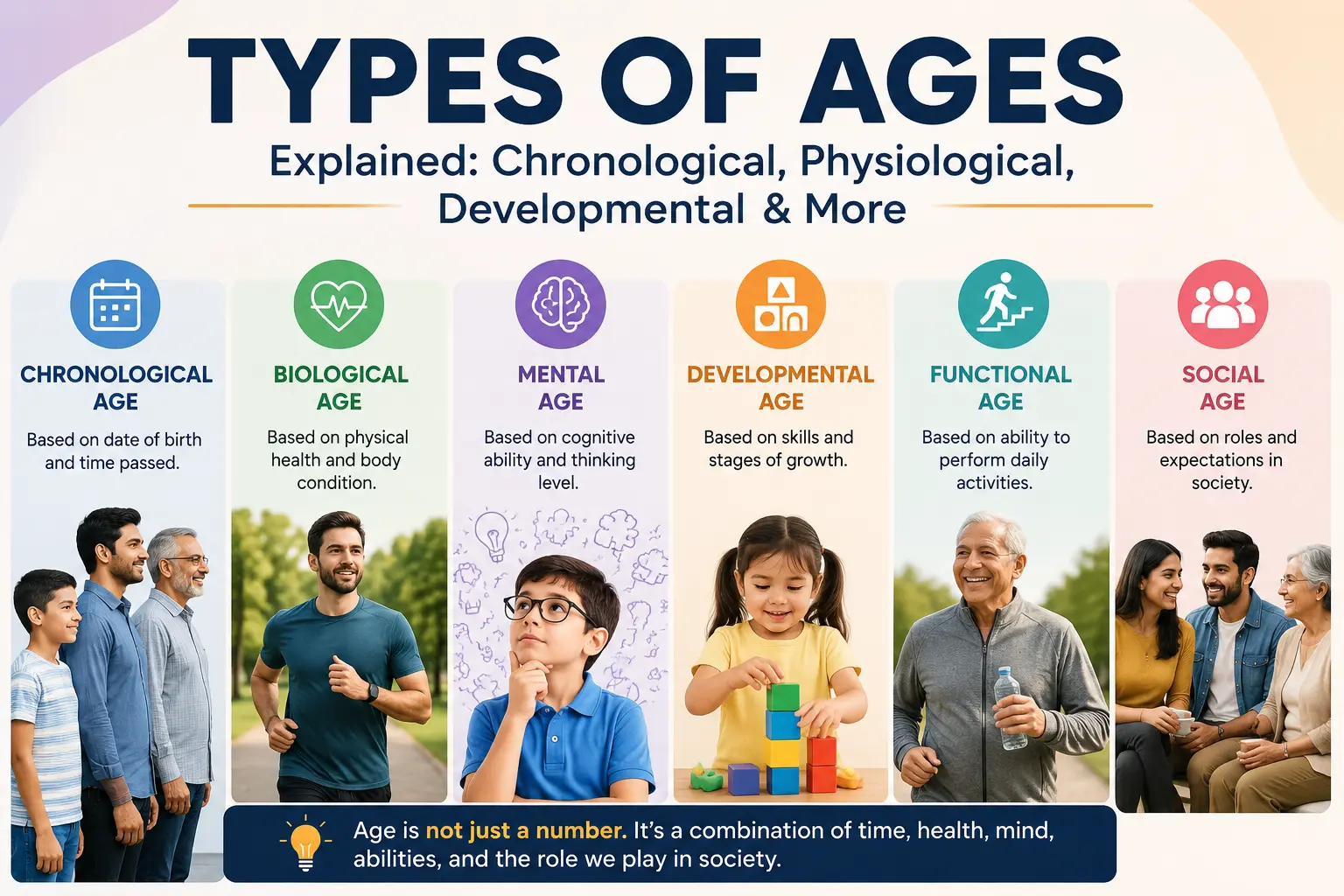
6 Types of Ages Explained: Chronological, Social & More
You don’t look 40.
She is very mature for her age.
He is 70 but still more active than young people.
Have you ever heard people say things like this? These are not just casual comments people make in everyday life, they actually point toward something very interesting. The idea of different types of ages helps explain why two people born in the same year can still behave, think, grow, or function very differently from each other. That is because humans do not have just one type of age and each type tells us different story about a person’s body, mind and development.
Table of Contents
What Are the Different Types of Ages in Humans?
Most people think age is just one number, that you check your birthday, count the years passed, and that’s it, you get your age. But age is actually more than that and there are different types of ages, and each age types tells you something different about a person. Some measure time, some measure health and some measure how a person thinks or moves or fits into society. Some experts also use terms like psychological age or emotional age to describe emotional maturity and behaviour patterns.
When understanding various types of ages teachers, doctors, lawyers, and parents make better decisions in life. In this guide, we explain all the major types of ages that people search these days, what they mean, how they differ, and why human age categories matters.
Chronological Age Explained
We all have been counting our age from our birthdays and we call that number our age, right?. Well we are not wrong here because telling our age in years is part of what your chronological age means. This is one of the most basic types of ages and it is the number of years, months, and days a person has lived since they were born.
This is the age mentioned on your passport, birth certificate, school forms, your driving license or any other documents. When people say they are 30 years old, they are talking about their chronological age not only their calendar age. It increases yearly for everyone and doesn’t depend on your health, lifestyle, or habits and it cannot be decreased.
How It Is Calculated
Most people upon asking their age just calculate it in years from their birthdays by subtracting from the current age. This calculation is not wrong but it gives an idea of the years the person lived on this planet since the day they were born. But the calendar age, unlike other types of ages, is calculated by 3 different methods since it is not only expressed in years but in months and days too.
- The first and most common method of calculating age is manually by hand using pen & paper by doing the simple math operations.
- The second method is using an online chronological age calculator, which is easy and the tool gives accurate results within seconds.
- The third method is chronological age calculator Excel with entering Excel formulas of DATEDIF in Excel or Google sheets which is ideal for bulk chronological age calculation.
For example:
- Date of birth: 10 March 2010
- Reference date: 10 May 2026
- Result: 16 years, 2 months, 0 days
Want to calculate chronological age manually or with Excel formulas? Read our full guide here.
How to calculate chronological age manually & with Excel Formulas
Biological Age Definition
Do you know that two people of the same age having the same birthday can have their bodies tell completely different stories? The reason for this difference is the difference in their biological age which is defined as how old your body actually is based on its body organs performing condition. Biological age also called Physiological age depends upon cell health, organ function, genetics, diet, and lifestyle and it can be higher or lower than your actual age.
A person who exercises regularly, eats well, and avoids smoking may be 40 chronologically but have a biological age of 33. Another person having the same age of 40 with poor lifestyle and habits may have a biological age of 50.
How Biological Age Is Calculated:
Like other types of ages, Biological age cannot be calculated with a simple formula, It requires medical assessments, blood tests, and physiological markers. Want to understand about this more and the difference between chronological and biological age in detail?
Read our full guide: Chronological Age vs Biological Age →
Mental Age Definition
Have you ever met a 10-year-old who thinks like an adult? Or a grown-up man who still acts like a child? That gap between their age and their thinking level has a name which is a concept of Psychology and is called the Mental Age. It is a person’s level of cognitive development compared to what is expected at that age. It is not about how smart someone is, but it is about how their thinking and problem solving ability compares to others of the same type of age. Mental age was first introduced by psychologist Alfred Binet in the early 1900s to identify children who needed extra support in school.
Example Of Mental Age
If a 10-year-old child performs on a cognitive test the way an average 13-year-old would, that child has a mental age of 13, higher than their chronological age. And, if a 10-year-old performs at the level of a 7-year-old, their mental age is 7, which may indicate a learning difficulty or developmental delay. Mental age is used in educational psychology and cognitive assessments, not as a label, but as a tool for providing the right level of support.
Read more about the difference in chronological and mental age in this guide:
Chronological Age vs Mental Age →
What is Developmental Age
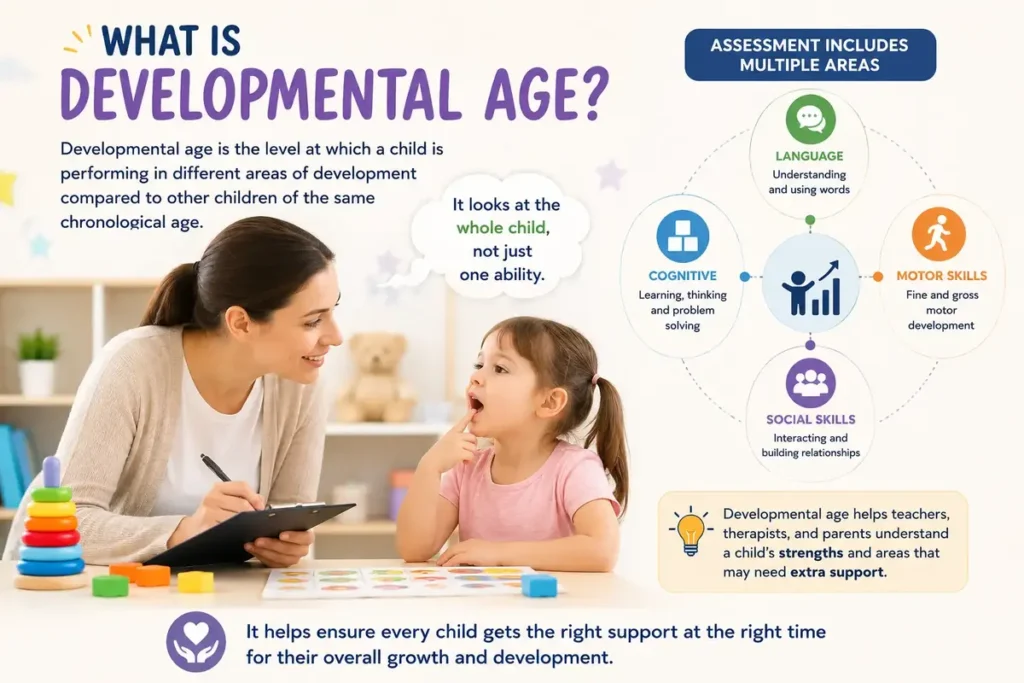
Your child just turned 5 but is not talking as much as other kids of the same age do, and you are not sure if that is something to worry about. The concept of developmental age answers exactly that which is the level at which a child is performing at different areas of development. The developmental age assessment includes the stages including language, motor skills and social skills, based on their stage of growth.
Unlike mental age, which only looks at thinking and problem solving ability, developmental age looks at the whole child across multiple areas at the same time. It is one of the most commonly used types of ages in early childhood assessments, special education, and therapy settings.
Role in Child Assessments and Education
When a child is struggling in any stage of life, professionals do not just look at their age they look at what the child can actually do. Developmental age is used in many different stages and areas to understand a child’s abilities and skills. These assessments help in making important decisions by the professionals and parents, which will help children later in their life.
For example, a 5-year-old may have a language developmental age of 3 years but a motor developmental age of 5 years. That kind of result helps teachers and therapists make a plan that actually fits the child and may make them able to lead a normal healthy life.
Speech-language therapy (SLP):
A therapist checks if a child’s language skills match what is normal for their age or needs help.
Role in Occupational therapy
Fine motor skills are compared with other kids to know what other kids of the same age can do.
School readiness checks
Teachers and psychologists use developmental age to decide if a child is ready for school or need some extra time and home care.
Special education:
Developmental age assessment helps find the exact areas where a special or differently abled child needs extra help to cope up in life.
How Developmental Age Relates to Chronological Age
Before any assessment begins, the first thing a professional writes down is the child’s date of birth, because the calendar age is the most important type of age in humans. Professionals compare a child’s actual skills to what is normally expected for their age and other kids of that same age have. This is why having the exact age in years, months, and days matters so much, and even a few months difference can make an impact in the results. The difference in chronological age vs developmental age does not mean something is wrong, rather it shows where the child is on their own path, so the right support can be given.
Key Note
Parents can use our Student Age Calculator to check school admission eligibility, expected grade placement, and school timeline based on a child’s date of birth.
What is Social Age
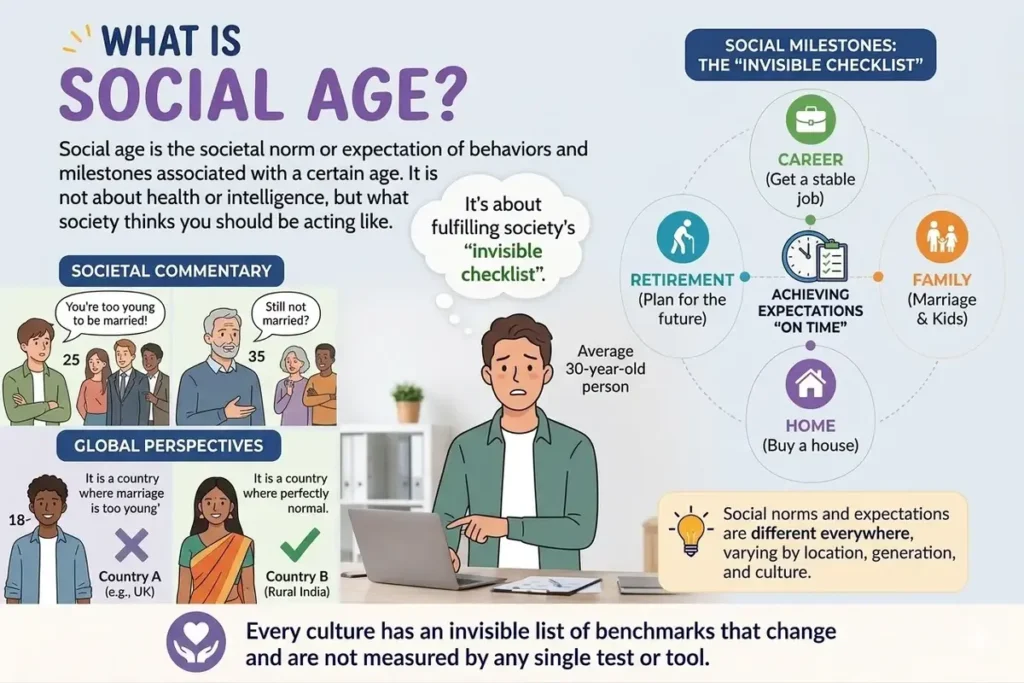
You are 30 and still not married? Sound familiar? This is the comment most of us have heard in our life. That comment is not about your health or your intelligence, but it is about what society expects from you at your age. That is exactly what social age definition is, it means the age society thinks you should be acting like, or the societal norm or expectation of behaviours associated with a certain age.
Every culture has an invisible checklist: get a job by this age, get married by that age, have kids, buy a house, retire and so on. When you follow these norms, you are on time and fulfill what society expects from you, but when you do not, people notice, right? But here is the thing is, these norms or expectations are different everywhere. Someone who marries at 18 is seen as too young in one country and perfectly normal in another. It is not measured by any test or tool, and it changes depending on where you live and what generation you belong to.
Social Age Changes With Generations Too
You probably heard your grandparents’ stories of their time that at 25, they were probably already married, had a job, and maybe even had a child. That was completely normal for their time, but today, a 25-year-old might still be in university, and figuring out their career, which is a new normal. This is because social age is not fixed, it changes with every generation, every culture, and every society.
Does Social Age Really Matter?
Social age does not appear on any form or document, no doctor measures it and no test gives you a score for it, but it affects real life more than people think. It influences the pressure people feel at certain ages, the decisions they make, and even how they see themselves. A person who is 35 and unmarried might feel completely fine about it, but the society around them might treat it as something unusual. That gap between how a person feels and what society expects is exactly where social age becomes something worth understanding. The important thing to remember is that this type of age is a reflection of society, not a reflection of who you are.
What Is Functional Age
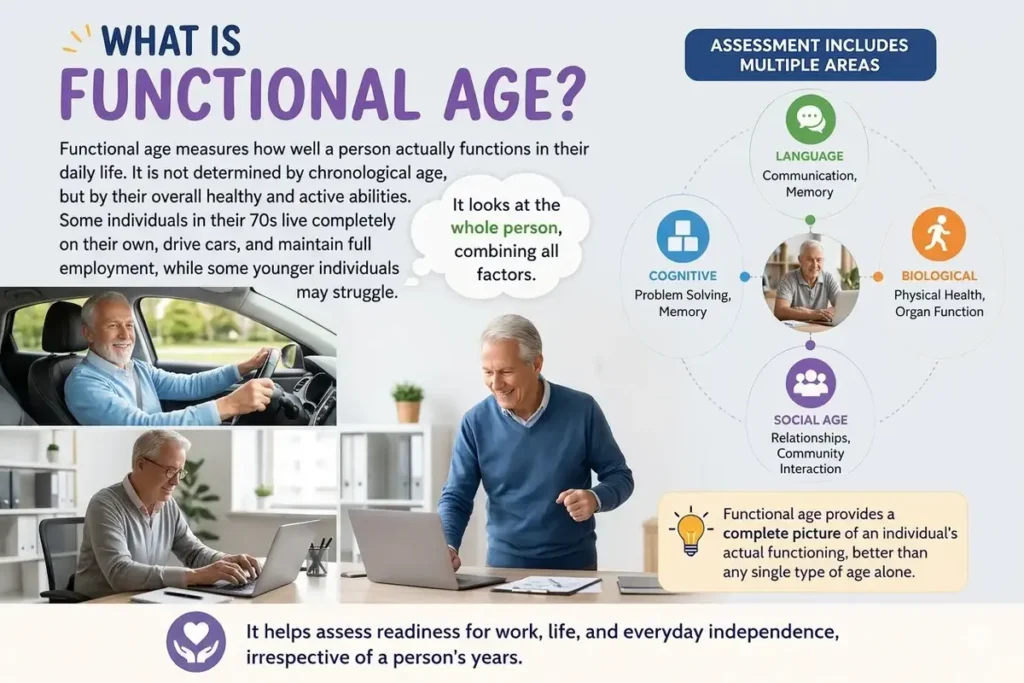
You have seen people who are 70 but live completely on their own, drive their car, and never miss a day of work. This is due to the fact that they are overall healthy and active and their abilities of functioning is good, this age of how well a person functions is called Functional Age. This type of age is not only one thing, but it is a combination of biological, psychological, and social age together, which measures how well a person is actually functioning in their daily life.
Someone can have a young biological age but still struggle with daily tasks, or have an older age but function better than most people half their age. This is why functional age gives a more complete picture than any single types of age on its own. Let’s take a look at where in the world functional age is used and assessed for everyday work and life.
Examples in Real Life
You might be surprised to know that functional age quietly shows up in places most people never think about, especially in environments like hospitals and elder care. In these situations, doctors do not only look at a patient’s age on paper, they also carefully observe what the patient can actually do on their own in daily life. After all, two 75-year-olds can have completely different care needs depending on their functional age.
In workplaces, employers often focus more on what an employee can actually do rather than just the age written on forms or documents. A 58-year-old who is active and performs well in daily tasks may have a much younger functional age than someone the same age who struggles to keep up with the workload. In fitness and sports, a 50-year-old athlete who runs faster and lifts more than a 30-year-old is a clear example that functional age can sometimes be far younger than chronological age.
What Makes Functional Age Different From Other Types Of Ages?
Biological age tells you how your body is doing on the inside. Mental age tells you about thinking ability. But functional age asks a very simple and practical question: what can this person actually do today?
These everyday abilities are what functional age measures, and they matter a lot more in real life than any number on a form.
Can You Improve Your Functional Age?
Here is something that most people do not know, and it is actually great news for us, that unlike your chronological age, functional age can actually improve. Regular exercise, staying socially active, eating well, keeping your mind engaged, and managing stress all have a direct impact on how well you function day to day. Functional age is one of the few types of ages that is actually in your hands, you cannot stop time, but you can absolutely change how well you live in it.
Types Of Ages | A Quick Comparison
We don’t have just one type of age, because age is not only about numbers but also about different aspects of human growth and life. Different types of ages help us understand how a person can develop mentally, physically, and socially in different ways even if their birth year is the same. This table gives a quick and clear comparison of the main types of ages and what each one actually represents in real life.
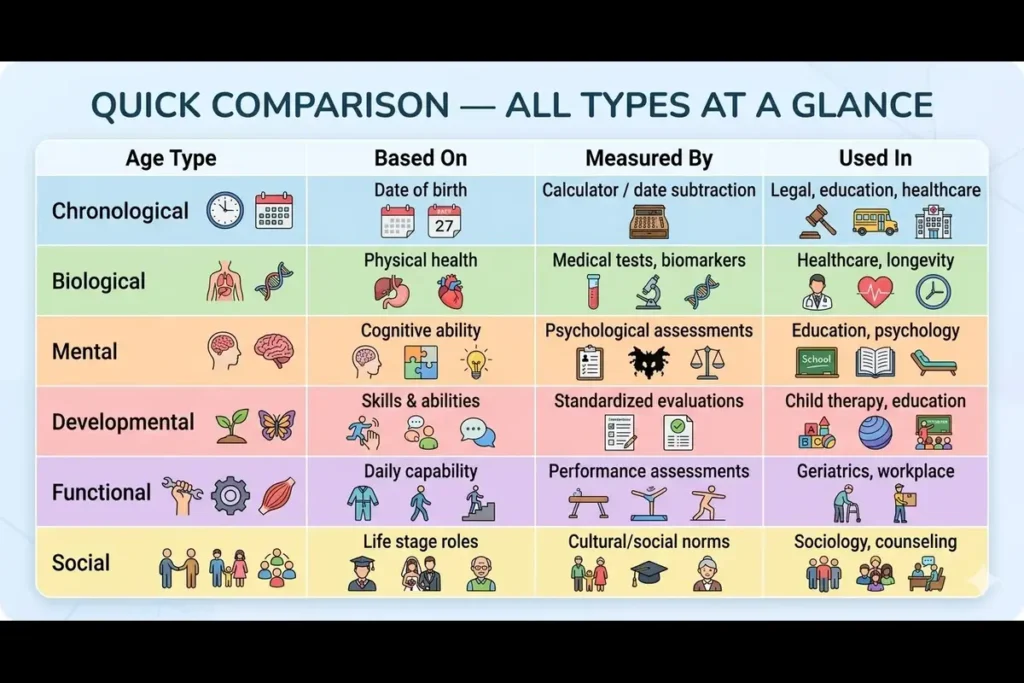
| Age Types | Based On | Measured By | Used In |
|---|---|---|---|
| Chronological | Date of birth | Calculator / date subtraction | Legal, education, healthcare |
| Biological | Physical health | Medical tests, biomarkers | Healthcare, longevity |
| Mental | Cognitive ability | Psychological assessments | Education, psychology |
| Developmental | Skills & abilities | Standardized evaluations | Child therapy, education |
| Functional | Daily capability | Performance assessments | Geriatrics, workplace |
| Social | Life stage roles | Cultural/social norms | Sociology, counseling |
Common Misconceptions About Age Types
Learning about different age categories also means getting a lot of wrong information about your age, age related behaviours, capabilities etc. Some of these misconceptions are so common that people repeat them without thinking twice, so we have compiled them for our readers. Let’s take a look at the most common myths and misconceptions, considered normal in the world and know the truth behind them.
Biological Age is Always More Accurate than Chronological Age
This is the most common among types of ages and lets pop the bubble, that it is not true. I agree that biological age is useful for understanding health trends but it is estimated, not exact. It cannot replace chronological age in school grade placement, legal or educational purposes.
Mental age Determines Intelligence Or IQ
Mental age just shows how a child is thinking at one point in time and it can change as the child grows, learns, and gets the right support. Mental age does not define how smart they are and it is not the same as IQ, and a child with a lower mental age today can absolutely catch up with the right care.
Developmental Age only Matters for Children With Disabilities.
It is checked for all children during routine health and school assessments, not just those with a need of treatment or with any diagnosis. It is a standard tool that helps track every child’s growth and progress and only means something needs attention when there is a gap between developmental and calendar based age.
Social Age is The Same Across Cultures.
Social age completely depends on the culture which means, what is considered a normal life societal behaviour at a certain age in one country can be very different in another. In some cultures, getting married at 20 is expected, but in others, it is considered too early. There is no universal checklist for social age and there never will be.
Frequently Asked Questions
Conclusion:
You have heard a phrase, Age is just a number, but we say, Age is not just one number, and now you know the reason behind it. Each type of age tells a different story about your body, mind, lifestyle, and habits and ways to manage them. Biological age tells you how your body is doing while Mental and developmental age show how a person is growing and thinking. Functional age shows what a person can actually do and Social age shows how a person fits into the world around them.
But all of them come back to one type of age that is most commonly used everywhere, and that is the chronological age which is the base on which every other type of age depends upon. Whether you need it for a school form, a clinical assessment, or a legal document, getting your exact age right in years, months, and days always matters.
Further Reading & References
- Different Perspectives of Age: Explore definitions and examples of age from psychological, social, and developmental perspectives through Study.com
- Biological vs Chronological Age: Learn about the difference between biological age and chronological age from experts at Mayo Clinic Press
- Social Age: Understand the concept of social age and its meaning in psychology through the American Psychological Association (APA) Dictionary.