
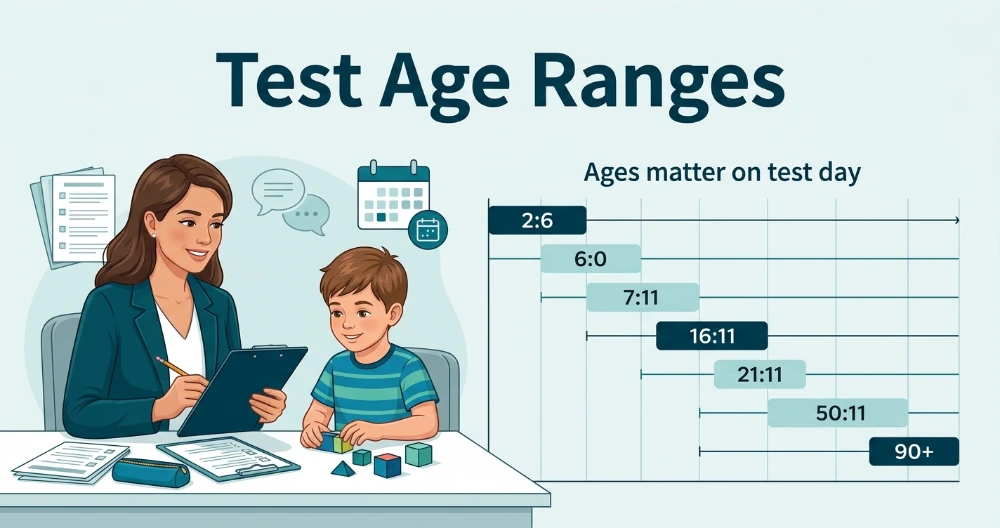
Test Age Ranges: The Chart Every SLP and School Psychologist Needs
If you give standardized tests, you already know the feeling. You have the student in front of you, the test on the table, and one quiet worry in the back of your mind: is this child actually the right age for this test?So we put the age ranges for the most-used tests in one simple chart. Bookmark this page, check it before you test, and let the calculator do the age math for you.
Work out a child’s exact age for any test date →
Quick Answer
Most tests only give valid scores inside a set age range, and it is the child’s chronological age on the day of testing that decides if you can use it. The WISC-V, for example, is built for ages 6 years, 0 months up to 16 years, 11 months. A child who is 5 years, 11 months on test day is not eligible yet.
The Test Age Range Chart
Ages are written the way test manuals write them. “6:0” means 6 years and 0 months. “16:11” means 16 years and 11 months. Publishers update their tests now and then, so always double-check the manual you are holding.
| Test | Full Name | What It Measures | Age Range | Publisher |
|---|---|---|---|---|
| WPPSI-IV | Wechsler Preschool & Primary Scale of Intelligence, 4th Ed. | Cognitive | 2:6 – 7:7 | Pearson |
| WISC-V | Wechsler Intelligence Scale for Children, 5th Ed. | Cognitive | 6:0 – 16:11 | Pearson |
| WAIS-IV | Wechsler Adult Intelligence Scale, 4th Ed. | Cognitive | 16:0 – 90:11 | Pearson |
| DAS-II | Differential Ability Scales, 2nd Ed. | Cognitive | 2:6 – 17:11 | Pearson |
| WIAT-4 | Wechsler Individual Achievement Test, 4th Ed. | Achievement | 4:0 – 50:11 | Pearson |
| KTEA-3 | Kaufman Test of Educational Achievement, 3rd Ed. | Achievement | 4:0 – 25:11 | Pearson |
| PLS-5 | Preschool Language Scales, 5th Ed. | Language | Birth – 7:11 | Pearson |
| CELF Preschool-3 | Clinical Evaluation of Language Fundamentals Preschool, 3rd Ed. | Language | 3:0 – 6:11 | Pearson |
| CELF-5 | Clinical Evaluation of Language Fundamentals, 5th Ed. | Language | 5:0 – 21:11 | Pearson |
| GFTA-3 | Goldman-Fristoe Test of Articulation, 3rd Ed. | Articulation | 2:0 – 21:11 | Pearson |
| PPVT-5 | Peabody Picture Vocabulary Test, 5th Ed. | Receptive Vocabulary | 2:6 and older | Pearson |
| EVT-3 | Expressive Vocabulary Test, 3rd Ed. | Expressive Vocabulary | 2:6 and older | Pearson |
| Vineland-3 | Vineland Adaptive Behavior Scales, 3rd Ed. | Adaptive Behavior | Birth – 90+ | Pearson |
Last updated: September 2026. These are the current US editions at the time of writing. Always confirm in your test manual before you start.
What Does “6:0” Actually Mean?
Test makers write age with a colon. The number before the colon is years, and the number after it is months. So “6:0” is 6 years and 0 months, and “8:4” is 8 years and 4 months. Simple as that.
Why so exact? Because the scoring tables are grouped by chronological age. If you want the basics first, here is a quick refresher on what chronological age really is. A child’s raw score gets compared to other kids in the same little age group. Pick the wrong group and the final score comes out wrong, even when you scored every answer perfectly. The age is not a detail. It is part of the score.
Why Can One Day Matter So Much?
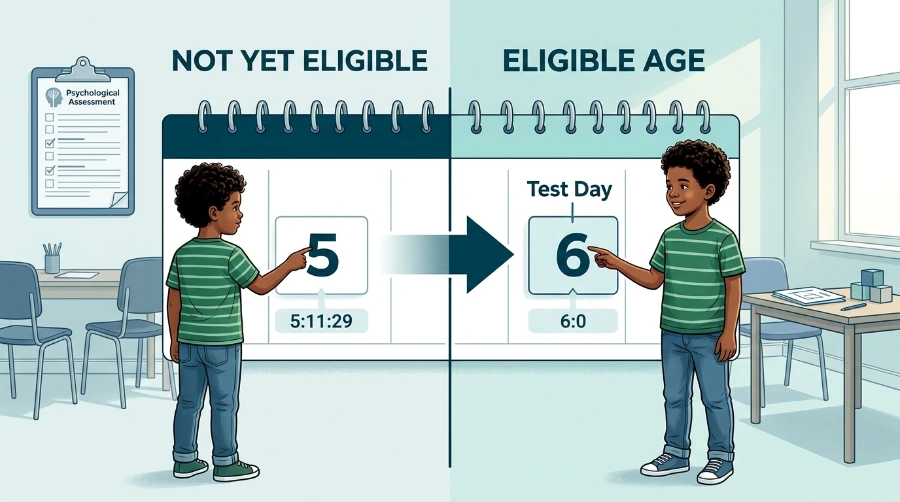
Because the age lines are hard lines. If a child is 5 years, 11 months, and 29 days on the day you plan to give the WISC-V, they are one day short of the 6:0 start line, and the test is not valid for them yet. Wait two days and that same child is 6:0 and good to go. The child did not change, only the calendar did.
This is the part people forget, the test date counts as much as the birthday. If a session gets pushed back a week, a child sitting near an age line can slip into a different test or a different scoring group. That is why you always want the child’s exact age for the real day you test, not the day you first booked it.
How Do You Work Out a Child’s Exact Age?
You can calculate chronological age by hand, or you can let the online calculator do it in a second. But, steer clear of common calculation mistakes to get exact age. Manual calculation method goes like this:
Say a child was born on March 15, 2015, and you test on September 10, 2024. Since 10 is smaller than 15, you borrow a month, and you land on 9 years, 5 months, 26 days. If that borrowing step is where you always second-guess yourself, you are not alone, and this is exactly the bit the tool takes off your plate. Just pop the two dates into the chronological age calculator and read the years, months, and days.
Which Cognitive Test Fits Which Age?
The Wechsler cognitive tests line up by age, and they overlap a little at the edges, which actually gives you options. The WPPSI-IV runs from 2:6 to 7:7. The WISC-V runs from 6:0 to 16:11. The WAIS-IV runs from 16:0 to 90:11. So a 6- or 7-year-old could fit both the WPPSI-IV and the WISC-V, and a 16-year-old could fit both the WISC-V and the WAIS-IV.
When a child lands in that overlap, the referral question and their ability level help you pick, and the manual walks you through it. If you want one test that covers a big span, the DAS-II goes all the way from 2:6 to 17:11.
What About Achievement Tests?
Achievement tests usually cover a wide age range. The WIAT-4 goes from 4:0 to 50:11, and the KTEA-3 goes from 4:0 to 25:11. You often pair one of these with a cognitive test when you are looking at a learning disability, so it helps to get the age right on both, since you will be comparing the scores.
What About Speech and Language Tests?
Speech and language tests start young and some reach well into adulthood. The PLS-5 covers birth to 7:11. The CELF Preschool-3 covers 3:0 to 6:11. The CELF-5 covers 5:0 to 21:11. For a five- or six-year-old who fits more than one, the manual and the reason for the referral help you choose. Articulation and vocabulary tests stretch even further, with the GFTA-3 at 2:0 to 21:11, and the PPVT-5 and EVT-3 both starting at 2:6 and running into older adulthood.
What Is Adaptive Behavior?
Adaptive tests cover the widest range of all. The Vineland-3 goes from birth right through age 90 and beyond. That is why you see it show up in so many evaluations, from tiny early-intervention kids all the way to adults.
Frequently Asked Questions
One Last Thing
Think of this chart as a quick check, not the last word. It is not here to replace your test manual or the call you make as the professional in the room. The ages you see match the current US editions as we write this, and publishers do change editions and norms over time, so things can shift. Before you give or score anything, take a second to check the age range in the manual in front of you, and make sure the child’s date of birth lines up with their official records.
And if you are looking at school placement rather than test eligibility, our student age calculator is the one built for that. Get the number right, and the rest of your day feels a whole lot easier.
Sources
Pearson Assessments product information and manuals for the WPPSI-IV, WISC-V, WAIS-IV, DAS-II, WIAT-4, KTEA-3, PLS-5, CELF Preschool-3, CELF-5, GFTA-3, PPVT-5, EVT-3, and Vineland-3.