
Common Chronological Age Mistakes (and How to Avoid Them)
You would think working out someone’s age is just simple subtraction, and most of the time it nearly is. Then a leap year shows up, or a birthday lands late in the month, and the number quietly goes wrong without you noticing. That is a problem when the age has to be exact, like for a school cut-off or a test score.
Quick Answer
The most common chronological age mistake is borrowing the wrong number of days when the subtraction goes negative. Close behind it are treating every month as 30 days, forgetting leap years, reading the date in the wrong format, and using today’s date instead of the actual test date. Each one is easy to make by hand, and each one is easy to skip with a calculator.
Quick Look On The Chronological Age Mistakes Calculation
Here is the short version of 8 common chrono age mistakes, and each mistake is explained in full below the table.
| The Mistake | Why It Happens | How to Avoid It |
|---|---|---|
| Borrowing the wrong way | Days or months go negative and get fixed wrong | Work days, then months, then years, and borrow as you go |
| Treating every month as 30 days | A quick shortcut that ignores real month lengths | Use the actual days in the month you borrow from |
| Forgetting leap years | February 29 gets skipped | Count the extra day when the span crosses one |
| Reading the date format wrong | DD/MM and MM/DD look identical | Write day, month, year clearly and check the order |
| Using today instead of the test date | Habit of defaulting to today | Enter the real date the age is needed for |
| Giving a decimal like 8.4 years | Rounding to one number | Report exact years, months, and days |
| Rounding up near a birthday | “Close enough” at an age boundary | Check the exact age to the day near any cut-off |
| Not checking the birth date | A typo or a date typed from memory | Confirm the date of birth against official records |
Common Chronological Age Mistakes We Noticed
Below are the mistakes we see most often. Each one has a quick example and an easy fix. If you would rather not risk any of them, you can use our free chronological age calculator and let it handle the math.
1. Borrowing the Wrong Way
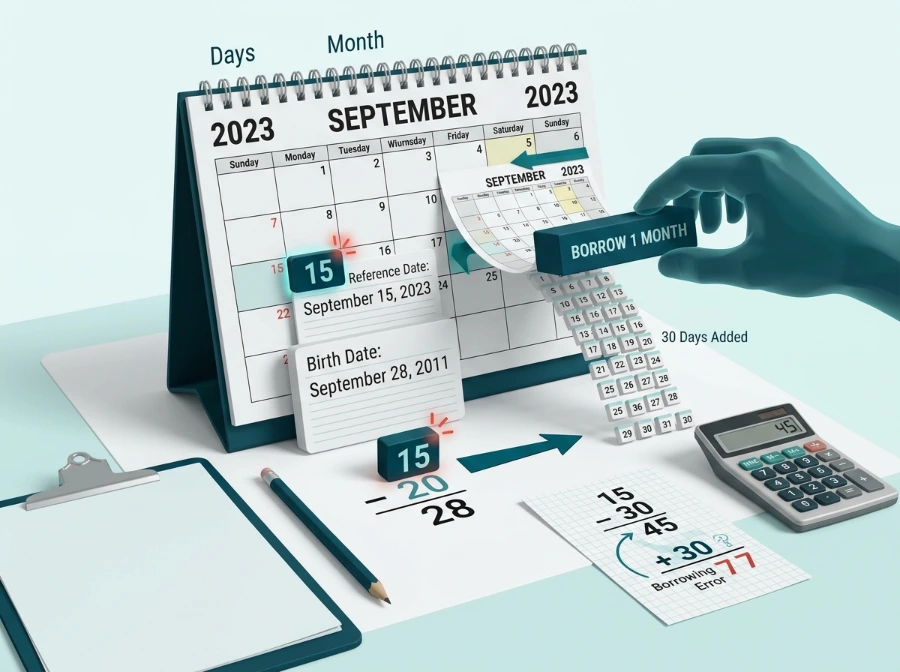
This is the one that trips people up the most. When you subtract the birth date from the reference date and the days come out negative, you have to borrow a month. When the months come out negative, you borrow a year. It sounds simple, but it is easy to borrow the wrong number of days, or to forget the step entirely and end up with a minus number sitting in your answer.
Here is how it goes wrong. A child is born on March 20, and you are checking their age on September 5. The day part is 5 minus 20, which is negative, so you borrow a month and add the days from August. Skip that, and your day count is simply off. The way to stay safe is to always work in the same order: days first, then months, then years, borrowing as you move up.
2. Assuming Every Month Has 30 Days
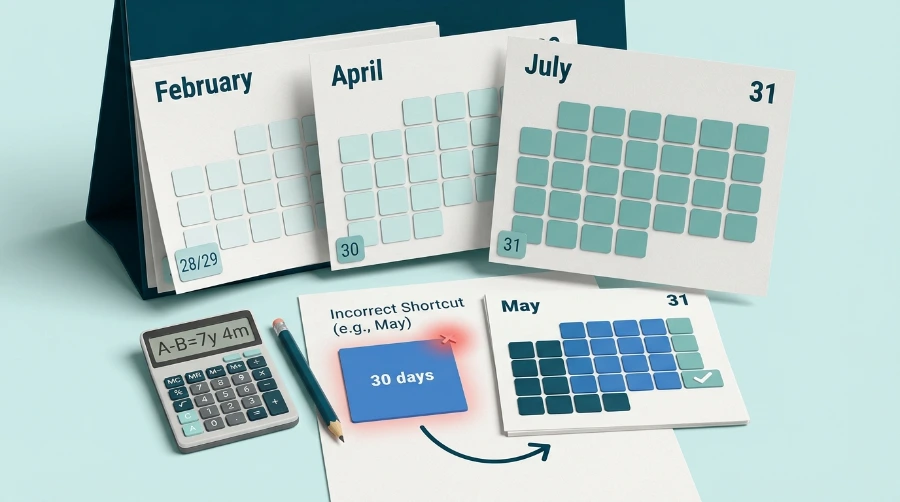
Some quick methods pretend every month has 30 days because it makes the math easier. The trouble is that months are not equal. They run from 28 to 31 days, so that shortcut slowly adds errors you cannot see. When you borrow a month, use the real number of days in that particular month, not a flat 30. February is the one that catches people out the most, especially in a leap year.
3. Forgetting Leap Years
A leap year adds an extra day, February 29, and if you leave it out your count can be a day short. Under the calendar we use, a leap year happens every four years, with an adjustment for century years, so February 29 turns up more often than people expect. It matters most for children born in late February or early March, or any time the span you are measuring crosses a leap year. Always count that extra day. A calculator does it for you without you thinking about it.

4. Reading the Date Format Wrong
The date format DD/MM and MM/DD look exactly the same until they don’t. “05/03” is March 5 in one format and May 3 in another, and if you read a birth date in the wrong order, the whole age is wrong and nothing on the page warns you. The fix is small but important: write the date out clearly as day, month, and year, and check the order before you start subtracting.

5. Using Today’s Date Instead of the Test Date
For assessments and school checks, the age that counts is the age on the actual day of testing, not the day you happen to be doing the paperwork. It is easy to default to today out of habit. But if a report is finished a week after the test, using today’s date gives you the wrong age for the record. Always enter the real reference date the age is meant for. This is exactly why our calculator lets you set any reference date instead of assuming today.

6. Giving a Decimal Age Instead of Years, Months, and Days
“8.4 years” is not the same as 8 years and 4 months, and that gap matters. Standardized tests and school forms almost always want the age as years, months, and days, because that is how their scoring tables are built. A rounded decimal throws away the detail they need. Always report the full breakdown, not a single decimal number.

7. Rounding Up Near a Birthday
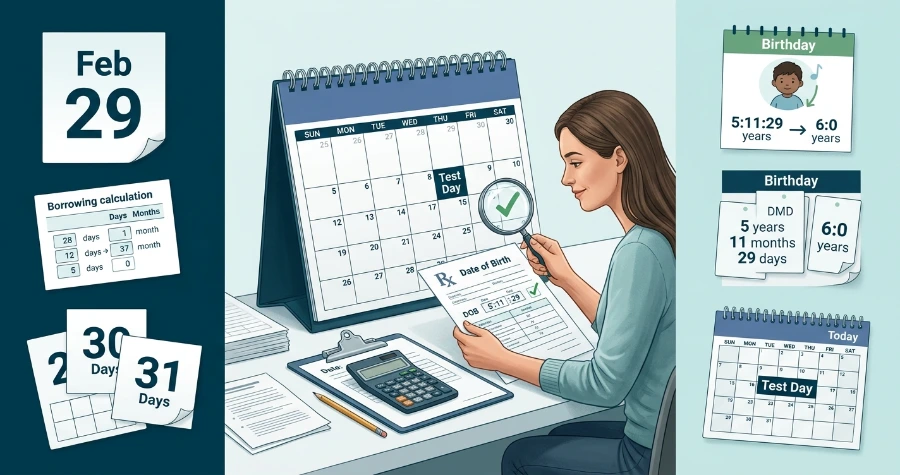
When a cut-off date or a test’s age range sits right on a birthday, a single day changes the answer. A child who is 5 years, 11 months, and 29 days is not 6 yet, even though they are almost there. Rounding up “because they are so close” feels harmless, but near a boundary it can change whether a child is eligible for a grade or a test. Near any cut-off, check the exact age down to the day.

8. Not Checking the Birth Date Against Records
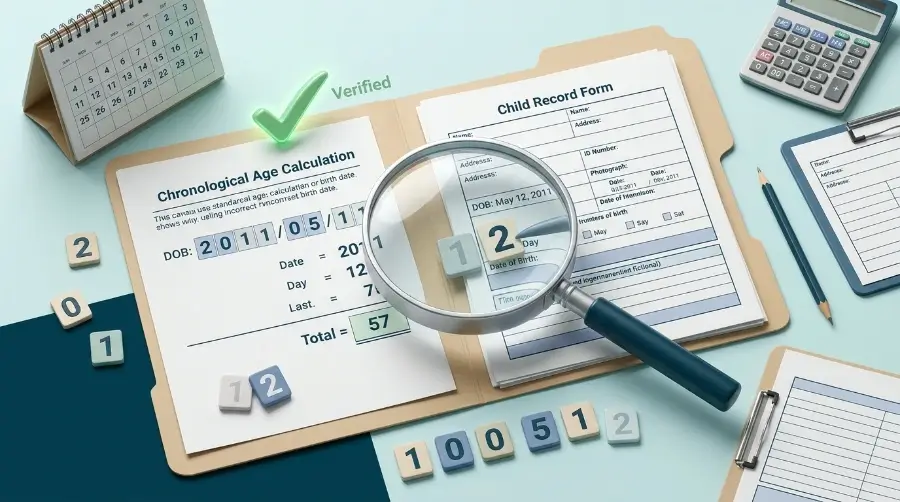
Even perfect math gives the wrong answer if the birth date going in is wrong. A single swapped digit, or a date typed from memory, quietly breaks everything after it. For anything official, take the extra few seconds to confirm the date of birth against the child’s records before you calculate. It is the easiest mistake to prevent and one of the most common.
The Easiest Way to Avoid All of These Chronological Age Mistakes
Notice that nearly every mistake on this list comes from doing the calendar math by hand. That is really the point. A calculator handles the borrowing, uses the true length of every month, counts leap years, and gives you the exact age in years, months, and days. You enter the date of birth and the reference or test date, and the whole list above just goes away.
Doing it by hand is fine for a rough check. But when the age has to be right, for a test, a school form, or an official record, let the tool do the arithmetic, and then confirm the birth date against the records. Try the free chronological age calculator, or if you want to do the math yourself check how to calculate chronological age manually.
Frequently Asked Questions
Bottom Line
This guide is here to help you get the number right. It is not a substitute for your test manual, your school district’s rules, or official records. When the age has to be exact, calculate it for the correct date and confirm the date of birth against the child’s records before you rely on it.